 Phryne's pavlova may have been ahead of its time. The earliest Australian recipe seems to be from the Australian Women's Weekly in July 1937, but only a year later Argus readers were writing in with their own recipes for "pavlova cake".
This is my mother's recipe, but it's probably no different to thousands of other mothers' pavlovas.
Where it differs from the classic pavlova is that it omits cornflour and it's the cornflour, I think, that gives the classic pavlova its dryness. This pavlova has a firm top, soft marshmallow centre and, if the sugar hasn't dissolved completely, lightly caramelised bits around the edges.
The essential ratio is 1/4 cup of sugar to one egg white, so the recipe can be adapted to a 1, 2 or 3-egg pavlova. I used four eggs, but since there were only two of us, I cut wedges from the pavlova and topped them individually with whipped cream and passionfruit. One passionfruit has enough pulp for two serves. The remaining pavlova shell will keep in an airtight container in the fridge for 2 -3 days.
Pavlova
4 egg whites
1 cup sugar
1 teasp vanilla essence
1 teasp white wine vinegar
1 small carton cream
1 tbsp caster sugar, optional
Pre-heat oven to 200 degrees C.
Beat egg whites until they form soft peaks, gradually add sugar, mix in well. Beat until the mixture changes size (it does), then fold in vanilla and vinegar. Roughly spread mixture onto a baking tray lined with baking paper. Immediately after placing pavlova in oven, turn down to 150 degrees, and cook for one hour. Turn off oven and leave to cool slowly. Do not open the oven door - fast cooling will crack the pav.
To assemble, whip the cream with a little caster sugar; spoon cream onto pavlova; top with passionfruit pulp. Serve as is, or with vanilla ice-cream.
 These days, apparently, perfectly whirled peaks of pommes duchesse can be bought frozen, and even the Women's Weekly, as far back as 1970, instructed cooks form their potatoes into little peaks by putting their potato paste in a piping bag with a star tube and piping small pyramids onto greased baking paper. I followed an earlier French recipe from Boulestin where the potato paste is placed on a board and cut into even-sized squares, but my paste proved resistant to shaping so, in the end, I dolloped it onto the baking sheet. Was it worth the effort? Not really. I prefer potatoes mashed with butter and cream.
Crumbed Lamb Cutlets
3 French-cut lamb cutlets per person
1-2 tbsp plain flour, seasoned with salt and cayenne pepper
1 egg white, beaten, with a little water added
fresh breadcrumbs
oil for frying
lemon wedges
Sift flour, salt and pepper into bag containing cutlets; shake gently to dust evenly. Dip each cutlet into beaten egg, brush off excess; coat with breadcrumbs. When all cutlets are crumbed, refrigerate until ready to cook.
Pommes de Terre Duchesse
large floury potatoes, such as Dutch Cream
egg yolks
salt, pepper, nutmeg
Wash, scrub and cook in their skins some large floury potatoes. When cooked, peel and mash them and add the egg yolks (one yolk to every 250g potatoes); mixing well. Add a little butter and work the mixture well; season with salt, pepper and a little nutmeg. Put this mixture on a floured board and let it cool. Cut into equal-sized squares, paint these with the yolk of an egg (or melted butter); and bake until browned on top in a hot oven - about 10 minutes. While the potatoes are browning, put some peas on to boil and cook the cutlets.
In a shallow pan, heat oil and fry the cutlets until golden brown, about 4 minutes each side for slightly pink, turning once. Serve with potatoes and peas and lemon wedges.
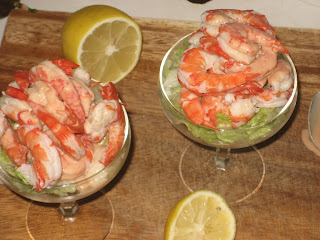 Oyster cocktails were all the rage in the 1920s but it wasn't long before other types of seafood joined the party - lobster, prawn, crab, prawn and crab, oyster and crab - all with zingy cocktail sauces. Interestingly, the Australian Women's Weekly Original Cookbook from 1970 gives much the same recipe for cocktail sauce as the Sydney Morning Herald did back in the 1920s: tomato sauce, Worcestershire sauce, vinegar, Tabasco, salt and whipped cream. I changed the Weekly's recipe by using half mayonnaise and half cream, but probably should have kept it as it was and whipped the cream for texture. Any type or size of prawn would do, but Tiger prawns are sweet and juicy and medium ones are bite size.
Prawn Cocktails
750g cooked medium Tiger prawns
1/4 iceberg lettuce, shredded
lemon slices
Cocktail Sauce
2 tbsp tomato sauce
2 teasp Worcestershire sauce
2 teasp lemon juice or vinegar
6 drops Tabasco sauce
1 tbsp fresh cream and 1 tbsp mayonnaise (or 2 tbsp cream, lightly whipped)
Salt, cayenne
Shell and de-vein the prawns. Combine all cocktail sauce ingredients; mix well. If using whipped cream, mix the other ingredients, season, and then fold in the cream. Line cocktail glasses with shredded lettuce, top with prawns and spoon over cocktail sauce. Serve with brown bread and butter and lemon slices. Serves 4.
For a while there I thought the Ritz French Cafe didn't exist, but in 1928 it was located at 110 Lonsdale Street, the site of Melbourne's famous Fasoli's Restaurant and Wine Bar. In the early 1900s Fasoli's was the centre of the city's literary and artistic life, with regulars including writers, poets, art critics and its own Queen of Bohemia.
"The rendezvous of connoisseurs", according to its advertising, the Ritz offered 5-course lunches and 7-course dinners and was licensed to sell Australian wines (Seppelt's).
So will it be Phryne's apres-theatre French supper at the Ritz with Ruddigore's leading man, Gwilym Evans, or her dinner at a Chinese restaurant in Little Bourke Street with her lover, Lin Chung? Steak and mushrooms, or crab with ginger, salt and pepper squid and lemon chicken? Pavlova and apple pie, or almond soup? Or Mrs B's home-cooked dinner of "excellent bouillion", fricasee of veal and apple crumble with cream. Or the lamb chops and pommes duchesse enjoyed on another night in?
I'm tempted to mix it all together - salt and pepper squid, lamb chops with pommes duchesse, passionfruit pavlova. A pity that Phryne has yet to encounter the duck spring roll.
Prawn Cocktails
Crumbed Lamb Cutlets with Pommes de Terre Duchesse and Peas
Passionfruit Pavlova
 Whiting appeared in a number of French guises on the poisson course of the Hotel Alexander's table d'hote menu - Filet of Whiting Orly, Whiting Joinville, Whiting Napolitaine, Whiting Richelieu, Whiting Fecampoise - but on the a la carte menu simply grilled or fried. Since breaded, or crumbed, whiting was popular elsewhere, I suspect some of those French names meant simply crumbed.
Crumbed Whiting
6 whiting fillets, about 300g
1 tablespoon plain flour
1 egg white, beaten
2-3 slices bread, a couple of days old
oil for frying
salt, cayenne pepper
lemon wedges
Slice the crusts off bread; discard. Cut the bread into small chunks and whiz in a food processor to fine crumbs. Lightly dust the fillets with flour seasoned with salt and cayenne, dip each into beaten egg white and coat with crumbs. Refrigerating for 30 minutes will make the crumbs adhere better. Fry in hot oil a few minutes each side, until golden. Garnish with lemon.
Serves 3 or 6 as an entree, 2 as a main.
 Did the Italian Society Cafe serve fettucine puttanesca in the 1920s? The cafe's menu has proved elusive, but Australian home cooks certainly cooked spaghetti - although probably not spaghetti Italians would recognise. (My fettucine recipe is below.)
Heinz and Rosella brands of spaghetti in tomato sauce were available in the 1920s, and in 1930 Hancock's Golden Crust Pty Ltd in South Yarra began producing macaroni under its "Kookaburra" brand, quickly expanding to spaghetti and vermicelli. By 1932 the company was exporting millions of cartons of pasta to England and the "Overseas Empire". Newspaper ads for Kookaburra spaghetti, macaroni and vermicelli included recipe suggestions such as Spaghetti with Oysters, Spaghetti a' L'Indienne (with curry) and Spaghetti with Mushrooms (served on toast).
Most recipes required the spaghetti strands to be broken up - even in the 1970s spaghetti was twice as long as it is now - and boiled in lightly salted water, with none of this "salty as the sea" nonsense, for at least 30 minutes. A Kookaburra recipe published in the Brisbane Courier in 1936 required 3 dozen oysters and their liquor, a double quantity of white sauce and 500g Kookaburra spaghetti. The cooked spaghetti and raw oysters are layered in a baking dish, the white sauce poured over, the whole topped with buttered breadcrumbs and baked in a hot oven for 10 to 15 minutes.
This more appealing recipe from the Sydney Morning Herald in 1936 calls for a dozen oysters, a small amount of spaghetti and a half quantity of white sauce seasoned with lemon juice and cayenne.
Spaghetti with Oysters
60g spaghetti
1 dozen oysters
15g butter
1 level dessertspoon plain flour
1/2 cup milk
juice of 1/2 lemon
Salt, cayenne
Break the spaghetti into 5cm lengths and cook in boiling salted water until tender; drain. In a saucepan, melt the butter, stir in the flour and cook on a low heat for a minute or two. Add the milk and stir until it boils and thickens. Season with lemon juice, salt and cayenne. Add the drained spaghetti to the sauce. Cut six of the oysters in half and add them to the spaghetti sauce. Pour into an ovenproof dish and lightly brown in a hot oven for five minutes. Put six whole oysters on top and serve garnished with parsley.
Fettucine Puttanesca
250g fettucine
1-2 tbsp olive oil
200g canned tomatoes
3-4 fresh ripe tomatoes, roughly chopped
2 cloves garlic, finely diced
2 small green chillies, finely chopped
12 Kalamata olives, stoned
6 anchovies
1 tbsp capers
Handful of fresh basil leaves, torn
parmesan or reggiano
Cook fettucine in salted boiling water. In a pan, heat the oil and cook the garlic and chillies for a minute or two. Add the tomatoes and simmer while the fettucine is cooking. Drain the fettucine. Add olives, anchovies and capers to tomato sauce and stir in the fettucine. Toss in the basil leaves. (If the basil in the photo looks odd, it's because The Bloke got Thia basil by mistake so I used it for garnish.) Top with grated parmesan or reggiano. Serves 3.
 I've lived within spitting distance of Sydney's Italian quarter for twenty years but, not having a sweet tooth, have never tried zabaglione. That was before I discovered how much alcohol is in it. Some recipes call for all white wine or champagne, but with figs, especially, the sweet fruitiness of marsala marries beautifully with the fruit. As Boronia marsala is hard to come by, I used an Australian substitute - Angrove Bookmark crema all 'ouvo. I tried the zabaglione with grilled figs as well, but the fresh ones were better.
This recipe is somewhat more recent than the others: it's based on one from the Australian Women's Weekly Italian Cooking Class Cookbook and before you scoff, I've known Chinese people who use the Women's Weekly Chinese Cooking Class Cookbook. The earliest Australian recipe I found for zabaglione was in Broken Hill's Barrier Miner in 1934, but it used fruit juice rather than marsala.
Zabaglione
5 egg yolks
1/4 cup white sugar
1/2 cup marsala
1/4 cup white wine
2-3 figs per person
Whisk the egg yolks and sugar in the top half of a double boiler, off the heat, until the sugar is incorporated into the yolks. Place double boiler on top of pan of boiling water and gradually whisk in the marsala and wine. Continue to cook, whisking, for about ten minutes until all the marsala and wine has been added and the mixture is thick and creamy. If it sticks, remove from the heat and beat with a wooden spoon. Serve with fresh figs. Serves 2 to 4.
 Phryne's pavlova may have been ahead of its time. The earliest Australian recipe seems to be from the Australian Women's Weekly in July 1937, but only a year later Argus readers were writing in with their own recipes for "pavlova cake".


