The original recipe is from Vesta’s column in Melbourne’s Argus, in July 1922, but the recipe for Split Pea and Ham Soup, made with the leftover Christmas ham, doesn’t really change much. Both recipes called for the dried peas to be soaked overnight, but split died green peas don’t seem to require soaking. The main difference between Vesta’s recipe and the one in the Women’s Weekly Original Cookbook from 1970 is that the Weekly’s has less water or stock and isn’t thickened with a white roux.
I’m going with the Weekly, but Vesta’s alternative recipe is here, too.
Unlike both recipes, I make the stock first, strain, allow to cool and skim off the fat.
Stock
1 ham bone, skin and fat removed
8 cups water
Onion
Bay leaf
Bring ham bone, water, onion and bay leaf to the boil. Reduce heat, simmer, skimming well, until meat is falling off the bone, approx 60 to 90 mins. Cool. Remove meat from bone, and dice. Discard ham bone, onion and bay leaf. Set stock and diced ham aside.
Split Pea and Ham Soup
250g green split peas
1 large onion, peeled and diced
1 medium carrot, peeled and diced
1 potato or small sweet potato, peeled and diced (optional)
1.5 litres stock
Reserved ham
Fresh or dried mint
Wash split peas well, drain. Put peas in a saucepan with diced vegetables. Bring slowly to the boil, skim well. Reduce heat, cover and simmer about an hour, or until peas are tender. Stir in diced ham. Season with salt and pepper. A little finely-chopped fresh mint can be added before serving.
Alternatively, Vesta’s recipe calls for the onion, carrot and split peas to be sautéed in one rounded tablespoon of dripping (or butter) for 5 minutes. Add 8 cups (2 litres) of water or stock and simmer until the peas are tender. Pass the soup through a sieve, return to the pot and heat, then stir through one level tablespoon of flour dissolved in cold water. Cook, stirring, for a few minutes. Season with salt and pepper.
Both recipes suggest topping the soup with small sippets of cubed bread, sautéed in butter, dripping or oil. Vesta suggests adding some dried powdered mint as well.
Tuesday, January 7, 2020

Tuesday, December 2, 2014
Christmas Special - The 1920s Canape
Canapes have been around for a while, but reached a peak of popularity in the 1920s and 30s when the cocktail party was in its prime. Parties could be short, a couple of hours from 5 til 7, or longer from 6.30 til about 9, or segue into dinner by another name with more substantial fare.
Canapes are simply pieces of bread cut into rounds, ovals, squares, rectangles or triangles, fried and topped with savoury mixtures of seafood, nuts, eggs, sauces and garnishes. They ranged from lobster slices on creamy lobster butter to tomato sauce spread on bread, baked and then topped with a slice of tomato and cucumber, a dollop of mayonnaise and an olive.
Anchovy or sardine canapes were economical, and exoticised with names likes Canapes Lucia and Canapes Julia.
Tomato Canapes
3-4 slices bread, stamped into rounds with a pastry cutter (or shot glass) or cut into fingers
tomato ketchup
fresh tomato
cucumber
mayonnaise
cream
stuffed olives
(Anchovy) Canapes Lucia
3-4 slices stale white bread
12 anchovy fillets
1 - 2 eggs, hard-boiled, peeled and finely chopped
butter
watercress
Cut the bread into slices 1/3 inch thick, stamp out into 12 rounds, fry in butter, then top each round with a curl of anchovy, fill the centre with chopped egg and garnish with a sprig of watercress.
(Sardine) Canapes Julia
3-4 slices toasted bread
cream cheese
cayenne pepper
sardines, boned and skinned
Cut the bread into 12 ovals or fingers, spread thickly with cream cheese mixed with a little cayenne, top each with a sardine.
Lobster Canapes
3-4 slices bread, stamped into 12 rounds
butter
lobster
oil and vinegar
capers
endive or lettuce
For the 5 til 7 cocktail party, the Adelaide News suggested savoury snacks such as potato chips, pickled onions, salted almonds, olives, anchovies and cream cheese on tiny biscuits, celery boats stuffed with cream cheese, tiny sausages grilled and served on sticks. A longer cocktail party called for oysters, freshly opened and set out on plates with bowls of sauces of different kinds to go with them; slices of brown bread and butter for an accompaniment for the oysters; prawns, lobster, whitebait, and crab mayonnaise in pastry cases and all kinds of canapes.
Canapes are simply pieces of bread cut into rounds, ovals, squares, rectangles or triangles, fried and topped with savoury mixtures of seafood, nuts, eggs, sauces and garnishes. They ranged from lobster slices on creamy lobster butter to tomato sauce spread on bread, baked and then topped with a slice of tomato and cucumber, a dollop of mayonnaise and an olive.
Anchovy or sardine canapes were economical, and exoticised with names likes Canapes Lucia and Canapes Julia.
Tomato Canapes
3-4 slices bread, stamped into rounds with a pastry cutter (or shot glass) or cut into fingers
tomato ketchup
fresh tomato
cucumber
mayonnaise
cream
stuffed olives
Spread bread thickly with tomato ketchup, place on a baking sheet and bake in a hot oven for five minutes. On each piece of bread place a slice of tomato and a slice of cucumber. Top with a spoonful of mayonnaise thinned with whipped cream and a small stuffed olive.
(Anchovy) Canapes Lucia
3-4 slices stale white bread
12 anchovy fillets
1 - 2 eggs, hard-boiled, peeled and finely chopped
butter
watercress
Cut the bread into slices 1/3 inch thick, stamp out into 12 rounds, fry in butter, then top each round with a curl of anchovy, fill the centre with chopped egg and garnish with a sprig of watercress.
(Sardine) Canapes Julia
3-4 slices toasted bread
cream cheese
cayenne pepper
sardines, boned and skinned
Cut the bread into 12 ovals or fingers, spread thickly with cream cheese mixed with a little cayenne, top each with a sardine.
Lobster Canapes
3-4 slices bread, stamped into 12 rounds
butter
lobster
oil and vinegar
capers
endive or lettuce
Fry rounds of bread, drain them and let them cool. Cut small slices of lobster; soak these in oil and vinegar for a few moments. Spread the croutons with lobster butter; lay on each a slice of lobster and over it sprinkle a few capers. Serve cold on a bed of very finely cut light-green endive or lettuce.
Lobster butter is made from the coral of a lobster, fresh butter, salt and cayenne. Rub the coral smooth in a mortar, adding butter till it is of creamy consistency and of a deep red color. Add cayenne to taste and a little salt.
Friday, November 29, 2013
Christmas Special - The Cocktail Party
The cocktail party was pretty much invented in 1928 - in London, Paris and Washington - but Sydney and Melbourne were soon in the swing; Kerry Greenwood's Phryne Fisher novels are set in 1928; ergo the Christmas Special that rounds off Series 2 of Miss Fisher's Murder Mysteries will have a cocktail party theme. Here's an article from September 1928:
Cocktail Parties
The Vogue in London
"For a day the topic in London newspapers was the production of a blue cocktail. Every other color is possible, and the result of the discussion was the discovery that the only two colouring agents possible were the juice of the gentian (a blue flower which grows on the high Alps) and a French sirop known during the last century but not made now.
"A famous dress designer invites one to a dress parade and a cocktail party in the same reach - or an elaborately engraved invitation is sent, entitling you to spend an hour or so in a parchment and gold drawing-room, sipping from gold filigreed glasses, while mannequins parade in lovely clothes.
"At one of these combined functions given recently by Madame Luander and her sister, Lady Glenmorris, mannequins displayed a novelty - the cocktail party frock - designed specially so that it is suitable for both late afternoon and dinner wear. Made in colored lace, the ensemble was particularly charming. In most cases the frock was sleeveless, and had an accompanying short coat of the same material, which could be slipped off to reveal the evening outfit."
To get in the mood, here's a recipe for a Minnehaha Cocktail from Melbourne's Argus in September 1928:
The juice of one-quarter of an orange
1 fluid ounce Dry Gin
1 fluid ounce French Vermouth
1 fluid ounce Italian Vermouth
1 dash of Absinthe
Half fill the cocktail shaker with broken ice; add all ingredients except the Absinthe. Shake well and strain into cocktail glasses – then add the Absinthe.
Note: The original recipe calls for 1/6 of a gill of each spirit. An imperial gill is 5 fluid ounces.
Cocktail Parties
The Vogue in London
"The cocktail party seems to be firmly established with the smart set in London. Where women's committee meetings once assembled and imbibed weak tea afterwards, they are now mediums of the cocktail party, even when held in the morning.
"Certain "art-shows" and mannequin parades are not complete without it. At a recent show of paintings by a Russian with futuristic tendencies, arranged by the famous Sitwell family, green and gold cocktails were handed round.
"For a day the topic in London newspapers was the production of a blue cocktail. Every other color is possible, and the result of the discussion was the discovery that the only two colouring agents possible were the juice of the gentian (a blue flower which grows on the high Alps) and a French sirop known during the last century but not made now.
"Some of the newest designs for houses include a cocktail bar in one corner of the lounge. It is usually done in artistically panelled wood, luxuriously fitted with crystal bottles, glasses and shakers. Already a few hostesses have created their own recipes, the details of which are jealously guarded. Salt almonds, potato chips and caviare sandwiches are often served with them.
"A famous dress designer invites one to a dress parade and a cocktail party in the same reach - or an elaborately engraved invitation is sent, entitling you to spend an hour or so in a parchment and gold drawing-room, sipping from gold filigreed glasses, while mannequins parade in lovely clothes.
"At one of these combined functions given recently by Madame Luander and her sister, Lady Glenmorris, mannequins displayed a novelty - the cocktail party frock - designed specially so that it is suitable for both late afternoon and dinner wear. Made in colored lace, the ensemble was particularly charming. In most cases the frock was sleeveless, and had an accompanying short coat of the same material, which could be slipped off to reveal the evening outfit."
To get in the mood, here's a recipe for a Minnehaha Cocktail from Melbourne's Argus in September 1928:
The juice of one-quarter of an orange
1 fluid ounce Dry Gin
1 fluid ounce French Vermouth
1 fluid ounce Italian Vermouth
1 dash of Absinthe
Half fill the cocktail shaker with broken ice; add all ingredients except the Absinthe. Shake well and strain into cocktail glasses – then add the Absinthe.
Note: The original recipe calls for 1/6 of a gill of each spirit. An imperial gill is 5 fluid ounces.
Friday, September 20, 2013
Agneau Roti Provençal, or Roast Lamb Provençal
This is another one of Boulestin's recipes. The lamb is roasted with a clove of garlic inserted near the bone and the flesh larded with a dozen or so anchovies. (If you don't have a larding needle, stab the lamb with a small narrow knife and push the anchovy pieces in.) The quantity of sauce is not huge, but it is very piquant. The lamb should be rare, and rested for 20 minutes. At this stage the pan juices can be poured into a glass and placed in the freezer for a few minutes so the fat can be easily removed. Any juices that run out while resting or carving the lamb can be added to the sauce at the end.
Roast Lamb Provençal
1 leg of lamb
1 clove garlic
anchovies
30-40g butter
1 small onion, finely chopped
2 shallots, finely chopped
plain flour
2-3 gherkins, chopped
1 dessertspoon tomato puree
1 cup water, stock or white wine
salt, pepper
Take a leg of lamb. Insert a small clove of garlic near the bone, and lard with small pieces of anchovy about 3cm long, about a dozen in all. Roast in the ordinary way, basting often. When cooked, remove it, keep it hot and skim the fat from the pan juices.
For the sauce, saute the onion and shallots in butter until they are more melted than fried. Sprinkle with a little flour, cook for one minute more; then add two anchovy fillets, the gherkins, tomato puree, the pan juices and a little water or stock. Cook for two minutes more. The sauce should be highly seasoned and can be strained before serving (though Boulestin doesn't).
Roast Lamb Provençal
1 leg of lamb
1 clove garlic
anchovies
30-40g butter
1 small onion, finely chopped
2 shallots, finely chopped
plain flour
2-3 gherkins, chopped
1 dessertspoon tomato puree
1 cup water, stock or white wine
salt, pepper
Take a leg of lamb. Insert a small clove of garlic near the bone, and lard with small pieces of anchovy about 3cm long, about a dozen in all. Roast in the ordinary way, basting often. When cooked, remove it, keep it hot and skim the fat from the pan juices.
For the sauce, saute the onion and shallots in butter until they are more melted than fried. Sprinkle with a little flour, cook for one minute more; then add two anchovy fillets, the gherkins, tomato puree, the pan juices and a little water or stock. Cook for two minutes more. The sauce should be highly seasoned and can be strained before serving (though Boulestin doesn't).
Monday, September 9, 2013
Celeriac and Oyster Soup
 This is my own recipe. I've made it with homemade fish stock and with vegetable stock but not with just plain water. The homemade fish stock worked best. This makes a thick soup that serves 2-3. For more, just use a larger celeriac (mine was organic and therefore small) and more liquid.
St John Restaurant in Smithfield serves a similar soup garnished with snails.
Celeriac and Oyster Soup
1 small bulb celeriac, peeled and thinly sliced
1 medium potato, peeled and sliced
1 small onion, peeled and finely sliced
50g butter
3 cups fish or vegetable stock or water
2 sprigs thyme
2 sprigs parsley
100ml cream or to taste
salt and pepper
6 oysters
On a low heat, saute the onion in butter until soft. Stir in the sliced celeriac and potato; add the fresh herbs; toss until coated; pour in the stock. Bring to the boil, reduce to a simmer and cook until the celeriac and potato are soft - about 10 or 15 minutes. Remove the herbs and blend until smooth.
Re-heat the soup, stir in cream, season with salt and pepper.
To serve, ladle soup into bowls, top each bowl with 2-3 oysters (squeezing a bit of lemon over the oysters first, if desired). Some finely chopped dill would have added to the visual appeal.
Sunday, September 8, 2013
Boeuf Provençal
 This is Boulestin's recipe for Braised Beef with White Wine and Olives from around 1910, so it's a fair bet that up-market gentlemen's clubs would have had something like it on the menu. I'm using King Island Beef from Coles which is allegedly pasture-grazed and hormone-free but not, it seems, from King Island. Kangaroo steak would possibly be better, and cheaper. I used French picholine olives which are easier to stone than green Sicilian olives.
 Boulestin does not give precise quantities, so these are my own.
Boeuf Provençal
750g beef, cut into medium-size squares
2 rashers bacon
2 onions, peeled and finely diced
1/2 cup olive oil
2 tablespoons plain flour
bouquet (a few thyme springs, parsley, a few bay leaves)
salt and pepper
1 cup white wine
2-3 ripe tomatoes
12 green olives
In a large saucepan, heat the oil until fairly hot; add the beef; stirring all the while, season with salt and freshly ground pepper, add the onions, sprinkle with flour. After a few minutes put in the bouquet and a cup of white wine and a cup of water. Bring to the boil, reduce to a simmer, cover and cook on a low heat for an hour or two until almost tender.
Meanwhile, peel and quarter the tomatoes; cut the bacon into small pieces and boil for a few minutes; stone the olives.
When the beef is almost tender, remove the pieces and place them in another saucepan with the tomatoes, bacon and olives. Pass the liquid in which the beef has cooked through a fine strainer (removing the thyme, parsley and bay leaves), pour this over the beef and simmer for a further 30 minutes on a low heat, shaking the pan occasionally.
Serve with steamed potatoes and a green vegetable.
Sunday, August 25, 2013
Series 2 Episode 1 - Murder Most Scandalous
The first episode of Series 2 screens on Friday 6 September, so it's time to restock the 1920s pantry shelf and find suitable recipes for a three-course 1920's dinner, ideally from the Melbourne's Argus newspaper.
Like two episodes in Series 1, Murder Most Scandalous does not seem to be based on any of Kerry Greenwood's novels. The Australian Television Information Archive gives this plot outline:
"When Jack's ex-father-in-law, Deputy Commissioner George Sanders, is implicated in the brutal murder of a prostitute, Jack is determined to clear his name. Despite strict instructions from Jack not to meddle in his case, Phryne decides to perfect her 'fan dance' in order to go undercover at the gentleman's club of the notorious Madam Lyon."
With no novel for inspiration, I'll assume that Madam Lyon is French, her establishment up-market and her clientele upper class. Oyster soup will feature, followed by a beef dish and an old-fashioned strawberry dessert.
Like two episodes in Series 1, Murder Most Scandalous does not seem to be based on any of Kerry Greenwood's novels. The Australian Television Information Archive gives this plot outline:
"When Jack's ex-father-in-law, Deputy Commissioner George Sanders, is implicated in the brutal murder of a prostitute, Jack is determined to clear his name. Despite strict instructions from Jack not to meddle in his case, Phryne decides to perfect her 'fan dance' in order to go undercover at the gentleman's club of the notorious Madam Lyon."
With no novel for inspiration, I'll assume that Madam Lyon is French, her establishment up-market and her clientele upper class. Oyster soup will feature, followed by a beef dish and an old-fashioned strawberry dessert.
Thursday, July 18, 2013
Winter Fruit Salad and Ice Cream
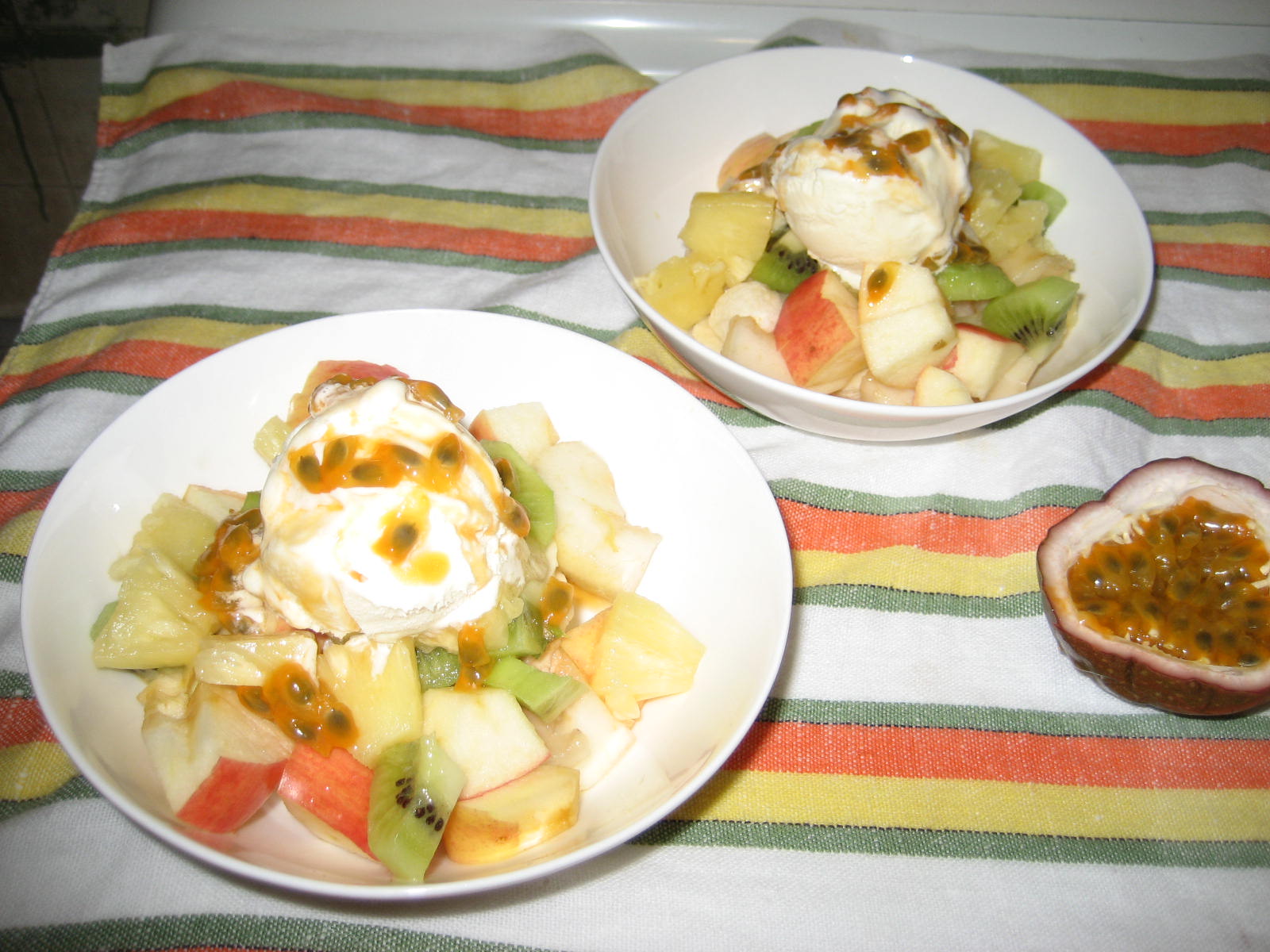 Fruit salad and ice cream makes at least one appearance at Phryne's St Kilda home, in Queen of the Flowers. Phryne has a refrigerator, but most homes wouldn't have - not in 1928 anyway. This recipe from Vesta's Women to Women pages in the Argus (28 March 1928) mentions neither ice cream nor whipped cream. Most of the fruits are winter fruits.
"The most satisfactory fruit salad is made with pineapple, bananas and pears as a basis. For six people a moderately large pineapple would be needed, with four good-sized bananas and four pears.
Before using, stir the contents of the bowl up in order to mix well. Other fruits may be added when they are in season. Strawberries make a delicious addition, so does passion-fruit. Peaches also blend well with the salad, and when there are no other fruits in season a little preserved ginger may be used with the foundation fruits. Apples are rather too film to be suitable for use in the salad. Rockmelons and raspberries are too strongly flavoured."
My winter fruit salad also had a basis of pineapple, bananas and pears. Pineapple isn't in season so I used tinned slices, an apple, kiwifruit and passionfruit. I think Vesta is right about the apple - it was a bit too crisp. Strawberries would have been better. I skipped the sugar, lemon juice and water. Preserved ginger sounds like an interesting twist.
Sunday, June 9, 2013
Lamb and Pearl Barley Soup
Barley soup appears in a couple of Kerry Greenwood novels, but none featuring Phryne. It's the sort of hearty winter meal that would appeal more to workers like Cec or Bert than a lady.
This recipe is adapted from one published in the Argus on 18 February 1931 as a "meatless" Lenten Dish. I've added a raw lamb bone for flavour (a shoulder, from which I cut most of the meat for a navarin of lamb later) but the soup is probably still good without it. Cutting the vegetables into fairly small pieces makes it more visually appealing.
I ended up omitting the milk, egg yolk and nutmeg even though they would make the soup smoother and richer.
Lamb and Pearl Barley Soup
60g or 1/2 cup pearl barley
1 lamb bone (shoulder or leg)
2 tablespoons butter
3 small carrots, thinly sliced
2 onions, diced
1 turnip, peeled and cut into small dice
1 stalk celery, sliced
6 peppercorns
2 cloves
thyme
parsley
1 blade mace (or nutmeg)
salt, pepper
250 ml milk
1 egg yolk
nutmeg
Put the pearl barley in a bowl, cover with water and soak overnight.
Saute 1 carrot and 1 onion in 1 tablespoon butter for a few minutes, without browning. Add the lamb bone, brown on all sides, the seasonings and 4 or 5 cups of water. Bring to the boil, skim, reduce heat and simmer for 1 to 1 1/2 hours or until the meat is falling from the bone.
Strain the stock, reserve the meat, discard the vegetables and seasonings. (Putting the stock in the freezer for 20 0r 30 minutes will make it easier to remove the fat.)
Saute the remaining onion, carrots, celery and turnip in 1 tablespoon butter for a few minutes until soft. Add the pearl barley, the lamb (cut into small pieces) and lamb stock; simmer for 20-30 minutes.
The soup can be thickened, if desired. Remove from heat. Stir in 250 ml milk, mixed with the beaten yolk of one egg, return to heat and add a dash of nutmeg.
Season to taste and serve with fried bread cut into slices.
This recipe is adapted from one published in the Argus on 18 February 1931 as a "meatless" Lenten Dish. I've added a raw lamb bone for flavour (a shoulder, from which I cut most of the meat for a navarin of lamb later) but the soup is probably still good without it. Cutting the vegetables into fairly small pieces makes it more visually appealing.
I ended up omitting the milk, egg yolk and nutmeg even though they would make the soup smoother and richer.
Lamb and Pearl Barley Soup
60g or 1/2 cup pearl barley
1 lamb bone (shoulder or leg)
2 tablespoons butter
3 small carrots, thinly sliced
2 onions, diced
1 turnip, peeled and cut into small dice
1 stalk celery, sliced
6 peppercorns
2 cloves
thyme
parsley
1 blade mace (or nutmeg)
salt, pepper
250 ml milk
1 egg yolk
nutmeg
Put the pearl barley in a bowl, cover with water and soak overnight.
Saute 1 carrot and 1 onion in 1 tablespoon butter for a few minutes, without browning. Add the lamb bone, brown on all sides, the seasonings and 4 or 5 cups of water. Bring to the boil, skim, reduce heat and simmer for 1 to 1 1/2 hours or until the meat is falling from the bone.
Strain the stock, reserve the meat, discard the vegetables and seasonings. (Putting the stock in the freezer for 20 0r 30 minutes will make it easier to remove the fat.)
Saute the remaining onion, carrots, celery and turnip in 1 tablespoon butter for a few minutes until soft. Add the pearl barley, the lamb (cut into small pieces) and lamb stock; simmer for 20-30 minutes.
The soup can be thickened, if desired. Remove from heat. Stir in 250 ml milk, mixed with the beaten yolk of one egg, return to heat and add a dash of nutmeg.
Season to taste and serve with fried bread cut into slices.
Wednesday, May 1, 2013
Carrot and Ginger Soup with Scallops
This isn't really a Phryne recipe, unless she happened to be in Provence some years after the time her novels are set and decided she'd like her cook to recreate this dish back in St Kilda. I used scallops that weren't in the shell, organic carrots and home-made vegetable stock.
Carrot and ginger soup with scallops
Serves 8
Serves 8
32 scallops, roe off
8 carrots, washed, peeled and cut into chunks
6 cm of fresh ginger root, peeled and grated
4 tbsp olive oil
3 cups chicken or vegetable stock
200 ml dry white wine
zest of 1 orange
300 ml cream
4 tbsp olive oil
3 cups chicken or vegetable stock
200 ml dry white wine
zest of 1 orange
300 ml cream
40 g butter
1 bunch flat-leaf parsley
Saute carrots and ginger in oil for 1 minute; add stock and white wine; cook 15-20 minutes over medium heat or until carrots are cooked but still slightly firm.
1 bunch flat-leaf parsley
Saute carrots and ginger in oil for 1 minute; add stock and white wine; cook 15-20 minutes over medium heat or until carrots are cooked but still slightly firm.
Remove
from heat; puree; add orange zest.
Brown
the scallops in butter for 1 min each side; remove scallops and set aside; reserve
pan juices.
Add
pan juices to carrot and ginger puree; add cream; bring to the boil, reduce
heat and simmer for about 1 minute.
Place puree in soup bowls, place scallops on top, garnish with parsley.
Place puree in soup bowls, place scallops on top, garnish with parsley.
Wednesday, April 24, 2013
Anzac Biscuits
Phryne Fisher drove ambulances in France during World War I. Bert and Cec are returned soldiers. Were they sent Anzac biscuits from home, biscuits made without eggs so they would keep?
There are no references to Anzac biscuits in any of the Phryne Fisher novels, but by the early 1920s readers were writing to Vesta, editor of the women's pages at the Argus, asking for recipes. The earliest recipe I could find actually called for two eggs and two teaspoons of cinnamon powder, but it did not appear until 1 May 1921 when it received an honorable mention in the Perth Sunday Times competition.
This recipe seems more authentic. It was published in July 1921, and again in June 1926, 1930, 1933... It makes about 2 dozen biscuits and contains no eggs. Don't be tempted to make bigger biscuits. The teaspoon of mixture makes a good Australian-sized biscuit.
Anzac Biscuits
2 breakfast cups rolled oats
1/2 cup sugar
1 scant cup plain flour
1/2 cup melted butter
1 tablespoon golden syrup
2 tablespoons boiling water
1 teaspoon bicarb of soda
Mix the golden syrup, boiling water and soda till they froth; then add the melted butter. Mix in the dry ingredients, and drop in teaspoonfuls on a floured tray. Bake in a slow oven, about 160 to 180 degrees, until golden. Enjoy with a mate and a cup of tea.
There are no references to Anzac biscuits in any of the Phryne Fisher novels, but by the early 1920s readers were writing to Vesta, editor of the women's pages at the Argus, asking for recipes. The earliest recipe I could find actually called for two eggs and two teaspoons of cinnamon powder, but it did not appear until 1 May 1921 when it received an honorable mention in the Perth Sunday Times competition.
This recipe seems more authentic. It was published in July 1921, and again in June 1926, 1930, 1933... It makes about 2 dozen biscuits and contains no eggs. Don't be tempted to make bigger biscuits. The teaspoon of mixture makes a good Australian-sized biscuit.
Anzac Biscuits
2 breakfast cups rolled oats
1/2 cup sugar
1 scant cup plain flour
1/2 cup melted butter
1 tablespoon golden syrup
2 tablespoons boiling water
1 teaspoon bicarb of soda
Mix the golden syrup, boiling water and soda till they froth; then add the melted butter. Mix in the dry ingredients, and drop in teaspoonfuls on a floured tray. Bake in a slow oven, about 160 to 180 degrees, until golden. Enjoy with a mate and a cup of tea.
Saturday, November 17, 2012
Whisky Mince Pies
Vesta's original recipe published in the Argus on 23 December 1937 calls for 1 gill of caramel, but since I don't know what form of caramel is meant and a later recipe is identical except that it uses brandy, I'm going with the hard stuff.
Whisky Mince Pies
375g raisins
250g sultana
125g currants
250g candied peel (orange and lemon)
2 large cooking apples, peeled, cored and cut into small cubes
250g suet, finely chopped, or 250g butter, melted
375g brown sugar
grated rind of one lemon and one orange and the juice of both
15g mixed spice
1/2 teaspoon cinnamon
4 tablespoons whisky or brandy
Finely chop or put through a fine mincer the raisins, sultanas, currants, apples and peel. Add the sugar, spices, rind and juice of the orange and lemon, the suet or melted butter and the whisky. Mix thoroughly, pack into a jar, cover and leave until required.
For the cases, make a good shortcrust pastry using 150g butter to 240g plain flour and mixing with water to a fairly stiff paste. Do not forget a pinch of salt, and, if liked, a tablespoon of sugar may be added. Rub the butter into the flour until the mixture looks like rough breadcrumbs. Then add the water.
Make the pastry early in the morning so that it will not become soft. Roll out to 1/2 cm thickness.
The pies may be made in rather big patty-pans, the pans being lined with pastry, and the tops put on and pinched. Butter the patty-pans before lining them, to ensure that the pies will slip out easily when cooked. Brush the tops with milk and sprinkle with very little sugar.
Christmas Pudding
This rich Christmas pudding is remarkably similar to the one published in Vesta's Woman to Woman column in the Argus on 9 January 1929. My mother handed it down to me and I fondly imagined her mother had passed it down from her Scottish foremothers. Maybe she just read the Argus.
Best made 7 to 14 days before required, my mother's recipe uses butter instead of suet and is flavoured with rum, sherry or whisky instead of the juice and rind of one lemon.
The recipe makes one large or three small puddings. I use a large aluminium steam pudding basin with clips but it can be boiled in a floured cloth.
Christmas Pudding
250g butter
250g brown sugar
5 eggs
250g sultanas
250g raisins
125g currants
60g dried figs
60g dates
60g maraschino cherries
60g blanched almonds, chopped
3 tablespoons rum, sherry or whisky
180g plain flour
180g soft breadcrumbs
1 teaspoon mixed spice
1 teaspoon ground cinnamon
1/2 teaspoon bi-carbonate of soda
Macerate fruits (sultanas, raisins, currants, figs, dates, cherries) in rum, sherry or whisky; cover with clingwrap and refrigerate overnight; stir in chopped almonds.
In a large mixing bowl, beat butter until soft; add sugar and beat to a cream; add eggs one at a time and beat evenly through.
Add prepared fruits alternately with sifted flour, breadcrumbs, spices and soda.
Place the mixture in a greased basin, leaving about 5 cms at the top. Cover with two thicknesses of greased paper or tinfoil, tie securely and steam in a saucepan of water with the lid on. The water needs to be 1/3 to 1/2 way up the basin and should be checked and topped up when necessary. Boil for 4 hours and again for 2 hours on the day of reheating. Serves 10-12.
Best made 7 to 14 days before required, my mother's recipe uses butter instead of suet and is flavoured with rum, sherry or whisky instead of the juice and rind of one lemon.
The recipe makes one large or three small puddings. I use a large aluminium steam pudding basin with clips but it can be boiled in a floured cloth.
Christmas Pudding
250g butter
250g brown sugar
5 eggs
250g sultanas
250g raisins
125g currants
60g dried figs
60g dates
60g maraschino cherries
60g blanched almonds, chopped
3 tablespoons rum, sherry or whisky
180g plain flour
180g soft breadcrumbs
1 teaspoon mixed spice
1 teaspoon ground cinnamon
1/2 teaspoon bi-carbonate of soda
Macerate fruits (sultanas, raisins, currants, figs, dates, cherries) in rum, sherry or whisky; cover with clingwrap and refrigerate overnight; stir in chopped almonds.
In a large mixing bowl, beat butter until soft; add sugar and beat to a cream; add eggs one at a time and beat evenly through.
Add prepared fruits alternately with sifted flour, breadcrumbs, spices and soda.
Place the mixture in a greased basin, leaving about 5 cms at the top. Cover with two thicknesses of greased paper or tinfoil, tie securely and steam in a saucepan of water with the lid on. The water needs to be 1/3 to 1/2 way up the basin and should be checked and topped up when necessary. Boil for 4 hours and again for 2 hours on the day of reheating. Serves 10-12.
Friday, August 10, 2012
Corned Beef with Cabbage and Potatoes
 |
| Corned Beef Hash |
When it comes to cooking corned beef there are probably as many variations as there are cooks. Some use two lots of water, bringing the meat to a simmer and discarding the first, briney lot and starting again - this time adding the onions, carrots and other flavourings. Some stud the cloves into one of the onions, and re-use the cooked onion to flavour the white sauce. Others add the onions and carrots to the water in the last 30-45 minutes of cooking and serve them with the meat.
Potatoes, mashed or boiled, and cabbage are the traditional sides. The cabbage can be thinly sliced and simmered, drained, and a little white vinegar and butter added at the end; or cut into wedges and boiled. Parsley sauce, mustard sauce or plain white sauce make good accompaniments, but so does ordinary Dijon or hot English mustard.
The leftovers can be made into a corned beef hash using roughly equal quantities of cold cooked potatoes, corned beef and - if you like - cabbage. Some 1930s recipes call for half a cup of water, milk or cream or a well-beaten egg to be added towards the end, but it is not really necessary. For a breakfast corned beef hash, a fried egg can go on top.
Potatoes, mashed or boiled, and cabbage are the traditional sides. The cabbage can be thinly sliced and simmered, drained, and a little white vinegar and butter added at the end; or cut into wedges and boiled. Parsley sauce, mustard sauce or plain white sauce make good accompaniments, but so does ordinary Dijon or hot English mustard.
The leftovers can be made into a corned beef hash using roughly equal quantities of cold cooked potatoes, corned beef and - if you like - cabbage. Some 1930s recipes call for half a cup of water, milk or cream or a well-beaten egg to be added towards the end, but it is not really necessary. For a breakfast corned beef hash, a fried egg can go on top.
Corned Beef with Cabbage and Potatoes
1.25-1.5 kg corned silverside or brisket on the bone
2 onions, peeled
2-3 carrots, peeled
2-3 bay leaves
6 cloves
8 peppercorns
1-2 tbsp brown or malt vinegar
1 dessertsp brown sugar
Wash meat well under running cold water to remove surface brine. Place in large saucepan, cover with water, add onions, carrots, bay leaves, cloves, peppercorns, vinegar and sugar. Cover, bring to the boil, reduce to a simmer and cook for approximately two hours, or until the meat is tender.
Serve with cabbage and small boiled potatoes brushed with melted butter and sprinkled with chopped parsley.
Corned Beef Hash
1 onion, finely chopped
30g butter
cold boiled potatoes, chopped into large chunks
paprika
corned beef, shredded into chunks or cut into pieces
cold cooked cabbage
In a large frypan, saute the onion in butter until soft and golden. Toss in the potatoes; sprinkle with paprika and salt. When the edges are lightly browned, toss through the corned beef and cabbage. Turn the mixture once or twice and continue to cook until heated through. Serve piled in the middle of a round bowl.
Saturday, August 4, 2012
The Fitted Kitchen
The 1920s and 30s saw architects, including women, design kitchens that would reduce housework, accommodate modern appliances and create a "nerve centre" for the small family. No
longer a large bare room at the back of the house, the kitchen was
positioned at the side or towards the front and preferably next to the dining room, to
which it could be linked by a small servery or hatch.
In America, "efficiency experts" had found that a circular work area in the kitchen reduced the number of steps a woman took while making a shortcake from 281 to 45 (Adelaide Mail, 9 August 1930). The circular work area places the stove, cupboards and refrigerator in one corner, with a "service table on wheels" that can be moved around the kitchen as needed. And quietly. It has rubber tyres.

This circular work area is in a relatively large kitchen, designed by an American woman, with an expensive "electric dish washer" next to the sink and a "planning desk" in the corner that houses a box of recipes, drawers for paid and unpaid bills, a telephone and a shelf for recipe books and "the loud speaker of a wireless set". The table, bottom right, seats four for breakfast and the children for lunch.
In Australia, "planning desks" and electric dish washers were less in demand, but work areas were similarly designed for efficiency.
The really efficient factory-like Australian kitchen probably
reached its apotheosis in an article by an architect using the
nom-de-plume Best Overend, A.R.I.B.A., AR.A.I.A. Published in the Argusin 1934 under the title: "Small-House Kitchen - Rounded Corners, Flush Surfaces
- Why Not Hose It Out?" the writer suggested that with no open shelves,
a linoleum floor and a tiled wall, "there seems no reason why the
modern kitchen should not be cleaned out and freshened with a hose - and
what a relief that might prove to overwrought feelings!" The breakfast
nook was redundant too, with "easy and direct access of the dining
alcove" (26 July 1934, p.13).
By 1938 the Argus observed that the kitchen "is generally becoming smaller
because it has been found that by carefully planning the position of the
stove, sink and drainer, food and crockery cupboards, and workbench,
less floor space is required".

In the smaller kitchen, the pantry disappeared, replaced by "cupboards placed in convenient positions around the walls. Fitted with flush panel doors these cupboards present an unbroken surface which does not collect dust. They are designed for the storage of foodstuffs or kitchen equipment. Cupboards for perishables are now ventilated from below the floor, with an outlet in the ceiling... The position of these cupboards is important for the convenient working of the kitchen. The grocery cupboard should be close to the back door, and the cabinets for the storage of china, glass, silver, and table linen should be convenient to the dining-room. The position of the cupboards, however, is governed by the shape of the room." (Argus, 19 August 1937)

Like the pantry, the breakfast nook was redundant. Best Overend suggested a dresser be built in "between the dining space and the kitchen, and this will incorporate a servery hatch with direct connection with the preparation table". Rather than having a large table in the middle of the kitchen "round which Cook wended her way to and from the stove and the sink", food would be prepared on a flap projecting from the wall making the "preparation of meals... more comparable with the assembling line of motor-car plant than a series of isolated operations" ( Argus, 11 October 1934, p. 7)
Saturday, June 23, 2012
Roast Shoulder of Lamb with Port and Redcurrant Jelly

This recipe is inspired by one that appeared in the Sydney Morning Herald on 18 December 1939 which suggested shoulder of lamb with redcurrant and mint jelly as an economical alternative to the traditional roast goose. The jelly can also be served with cold lamb, "turned out on small lettuce leaves".
Roast Shoulder of Lamb
1.25 kg shoulder of lamb
potatoes
parsnipssmall onions
salt, pepper
Season lamb, roast at 220 degrees Celsius for 15-20 minutes, reduce to 180 degrees and cook for a further 45 minutes. Add the potatoes, parsnips and onions to the baking dish; toss these in the melted lamb fat; cook for a further 45 minutes.
Remove the lamb and rest, covered, for 15 minutes before serving. Meanwhile increase the oven temperature to 220 degrees to brown the potatoes, parsnips and onions.
If desired, the lamb can be served with a thin gravy: Make a brown roux with 30g butter and 1 level tblsp flour, add 1 glass of white wine, the pan juices (from which the fat has been skimmed), season and simmer for a few minutes. Alternatively, reserve some of the port and redcurrant jelly, add the pan juices, water or stock, season and simmer for a few minutes.
Port and Redcurrant Jelly
100g redcurrant jelly
100ml port
1 tablespoon fresh mint, finely chopped (optional)
1 leaf gelatine, soaked in water for 5-7 minutes and squeezed out
In a small saucepan, gently heat the redcurrant jelly and port until the jelly has dissolved. Stir in the mint. Remove from heat, add the gelatine. Fill small moulds and place in the freezer to set.
Tuesday, June 19, 2012
Venison Pie

This venison pie can also be made with a commercial puff pastry, with the pastry on top of the pie only. Redcurrant jelly - about a tablespoon - can be added to the sauce, or served on the side.
Marinade
1 onion, sliced
1 carrot, sliced
1 French shallot, finely chopped
1 stalk celery, sliced
bouquet (bay leaf, parsley, thyme)
2 cloves
1 cup white wine vinegar
oil
Saute the onion, carrot, shallot and celery in a little oil for 1 minute; add the bouquet, cloves and vinegar, bring to the boil, reduce heat and simmer for 15 minutes. Allow the marinade to cool. When cold, pass through a sieve and pour over the venison, previously seasoned with salt and pepper. Turn the venison once or twice while marinating. Refrigerate for several hours or overnight.
Suet pastry
240 g plain flour
1/2 teaspoon baking powder
1/4 teaspoon salt
120g suet, finely chopped
90-100 ml water, approx.Sift flour, baking powder and salt into a basin and add the finely-chopped (or grated) suet. Mix with water to a soft dry dough, knead well in the basin. Alternatively, whiz all ingredients in a food processor, knead well on a floured surface. Roll into a smooth ball. Cover with cling wrap and refrigerate until the filling is ready.
Meat Filling
1 kg venison shoulder, diced into 2 cm pieces
1 onion, finely chopped
1 carrot, sliced
1 carrot, sliced
salt, pepper and herbs (parsley, thyme, bay leaf)
1 cup rich gravy
1 leaf gelatine
Strain the marinade, reserve. Dust venison pieces with seasoned flour, brown in butter, remove to a clean saucepan. Saute onion and carrot, in extra butter if needed, and add to the venison. Add warmed marinade and water sufficient to cover, simmer about an hour (for farmed venison). Strain off the liquid and reserve for the "gravy". Allow the meat to cool.
Venison Pie
Cut the pastry into two pieces, two-thirds for the base and sides of the pie dish and one-third for the cover.
Roll out the large piece of pastry, line the base and sides of the pie dish. Spoon in the meat filling, smooth the top.
Roll out the pie cover, cut a circle of pastry from the centre and set aside.
Brush the edges of the pie cover with beaten egg or milk, place on the top of the pie and pinch the edges together. Brush the top with beaten egg and bake in a moderately hot oven for 60 minutes.
Monday, June 18, 2012
Quince Jelly

Quince Jelly
3-4 quinces
1 cooking apple (preferably Golden Delicious or Granny Smith)
250 ml water
1 lemon, peeled and juiced
120g white sugar
1 egg white and egg shell
5 leaves gelatine
1 teaspoon cochineal (optional)
Whisk the egg white with a little water.
Put the quince and apple juice, the water, a little lemon juice and the rind, sugar, egg white and the egg shell into an enamel saucepan. Over a gentle heat, whisk the mixture until it comes to the boil; skim.
Meanwhile, soak the gelatine leaves in cold water for 5 to 7 minutes; remove the gelatine mass and gently squeeze out the water.
Take the pan off the heat, stir in the gelatine and cochineal (if used), cover the pan; let it stand ten minutes.
Pour a kettle of boiling water through a jelly bag (or a piece of muslin or a clean tea-towel) to warm it. When the water has drained off, pour in the jelly and let it strain into a wetted mould. (I put the wetted jelly mould in a large saucepan, placed the sieve across the top and draped the warm wet muslin across the sieve.) Refrigerate the jelly for at least 3 hours, or overnight, to set.
Subscribe to:
Posts (Atom)